Group Changes

A goal of Kurt’s is to do a better job of updating the website. Towards that, the group page has been updated. The biggest change is Dr. Zach Palmer has joined us last Fall in a joint postdoc with Dr. Greg Tschumper. Zach got his PhD. with Ryan Fortenberry at Ole Miss and is focusing on applying multicomponent methods to hydrogen-bonded and proton-transfer systems.

New Paper in J. Comp. Chem.

Dylan’s paper on benchmarking VPT2-DFT for computing dipole moments has been published in J. Comp. Chem. Dylan finds that including vibrational corrections using VPT2 only leads to a small increase in accuracy relative to standard DFT. The paper can be found here.

Postdoc Position Available

A joint computational chemistry postdoctoral research position between our research group and the group of Dr. Greg Tschumper at Missouri S&T is available. The position is based at Missouri S&T in Rolla, MO. The appointment can begin immediately but preferably no later than August 2025. The appointment is for 1 year (contingent upon satisfactory performance), but the appointment can be extended if additional funding for the project is secured.

More information about the position including needed qualifications and the process for applying can be found at the job posting.

Additionally, candidates can email Kurt for more information about the position or if they have any questions.

Summer News

Big news for the group.

We have been awarded a three-year NSF grant to implement the constrained multicomponent formalism using coupled-cluster theory and apply the methods to study vibrationally averaged properties of astrochemically relevant small molecules. Gabbie has been working hard on this well before we received the grant and we hope to have initial results soon.

We have also been awarded a three-year AFOSR grant to implement connected-triple contributions in polaritonic coupled-cluster theory. This grant is in collaboration with the Suits group. Their group will be performing exciting cavity ring-down spectroscopy experiments to detect molecular polaritons in the gas phase that we hope to interpret with out new theoretical methods.

Exciting times!

Group Changes

The group finally convinced Kurt to update the nearly two-year-old group photo, so it is also a good time to mention the considerable changes in the group over the last six months.

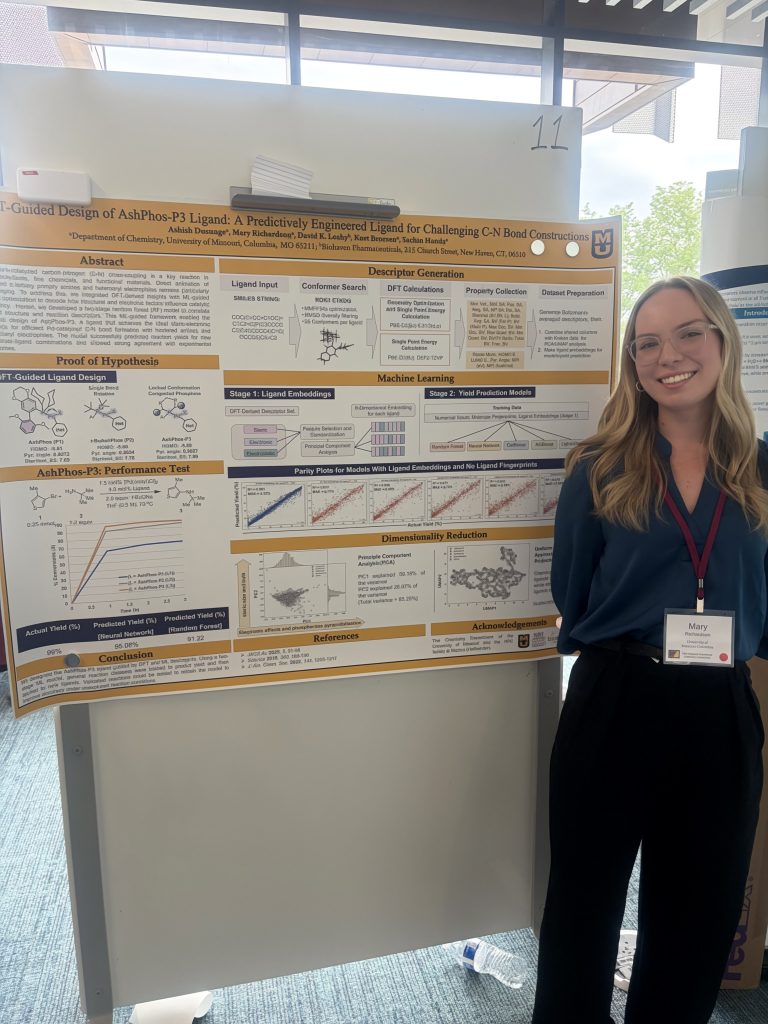
Two new graduate students, Mary Richardson and Colin Gopaul, have joined the group. Colin is joint advised with Prof. Matthias Young in Chemical Engineering.

Two new undergraduates, Matthew Cremer and Austin Richard, have joined the group. Matthew used to do research with our group as a high-school student through our ongoing partnership with Helias Catholic and Dr. Collin Mayhan.